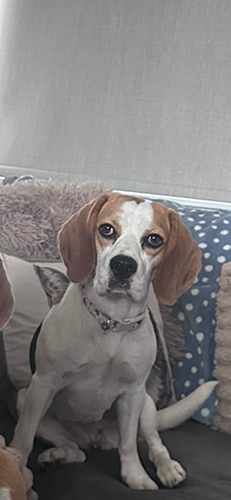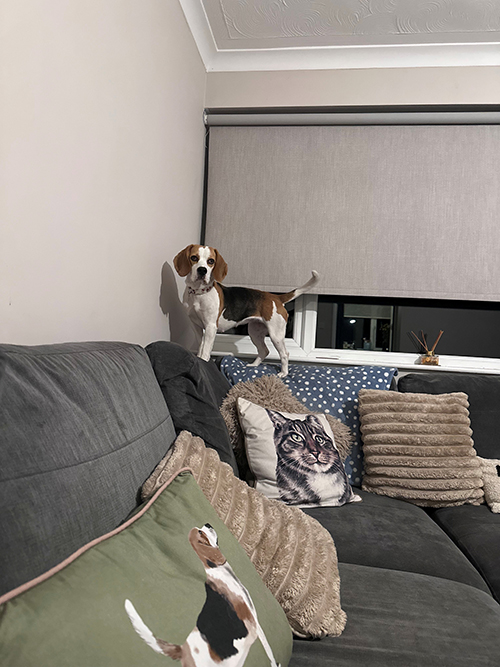
Honey is a pretty tri-coloured Beagle girl, weighing 11.6kg. She is a lively, energetic young dog who loves to play, particularly tug-of-war, and is very food motivated – a real Beagle trait! She is especially fond of anything fishy, including dried fish skin and salmon.
Training and Behaviour.
Honey has not yet attended formal training classes. She is walked on a harness, although she tends to pull; she walks better when wearing a Halti. She can be reactive towards dogs when out on lead, barking and lunging, but her owners have seen some improvement using the Halti and working on getting her to look towards them for guidance.
She can be wary of men and people wearing hoods, particularly in the dark.
Honey is housetrained, although when she becomes anxious she may have accidents. She is not destructive.
She has separation and confinement anxiety and currently cannot be left alone. Her owners have spoken with a dog behaviourist, who advised against crate training because of her confinement anxiety. They have gradually established the crate as a safe place in the evenings, and Honey will sleep in it overnight, although she can take a long time to settle. They have found that she has made better progress when not confined.
Honey travels well in the car with someone she knows. She is not let off lead.
Other Dogs
Honey is currently unable to live safely with another dog. Her owners describe her as an extremely energetic and persistent player, with little ability to switch off. If the resident dog moves away because she has had enough, Honey will follow, nip at her and continue the interaction. She has also bitten the other dog, causing her to yelp, including when she is on her bed or trying to get away.
The behaviour has become more frequent as Honey has settled into her current home, despite her owners intervening, redirecting her and giving her opportunities to calm down. The resident dog has had to be crated to keep her safe.
Honey has played with friends’ dogs and these interactions have reportedly been fine, although her play can be very rough and energetic. She also guards food around other dogs.
For these reasons, Honey needs to be the only dog in her new home. Her next owners will need to understand her play style, recognise when she is becoming over-aroused and help her learn to settle.
Cats
Honey’s owners say that she does not chase cats. She is interested in saying hello but will then wander off. However, her separation anxiety and unsettled behaviour have been stressful for the elderly cat in her current home. Any potential home with cats would therefore need careful consideration, with the welfare and wellbeing of the resident cat a priority.
Health
Honey has been examined by her vet to investigate whether pain could be contributing to her behaviour. Blood tests and a urine analysis were also carried out, with no problems identified.
She experiences separation and confinement anxiety and is currently prescribed Reconcile 16mg (fluoxetine). Her medication and behavioural support will need to continue under veterinary guidance.
Honey is not spayed. Her owners believe her last season was approximately four months ago. Her vaccination history is reported as up to date, but the date of her last vaccination is unknown. She was last wormed on 1 September 2026 and is microchipped.
Honey’s Ideal Home
Honey needs a patient, understanding and committed home with the time to help her work through her anxiety and develop the ability to settle. She cannot currently be left alone, so her new owners will need to be able to provide the company and gradual support she needs.
She must be the only dog in the household, as she is not currently able to share a home safely with another dog. Any home with cats would need careful assessment.
Honey has lots of energy, loves interaction and is highly responsive to food-based training. With consistency, appropriate behavioural support and an environment that meets her needs, we hope she can make progress and enjoy a happier, more settled life.